
UAE e-Invoicing Deadline Extended to October 30, 2026 — What Your Business Needs to Know
The UAE Ministry of Finance has officially extended the deadline for businesses to appoint an Accredited Service Provider (ASP)
5/12/20262 min read
UAE e-Invoicing Deadline Extended to October 30, 2026 — What Your Business Needs to Know
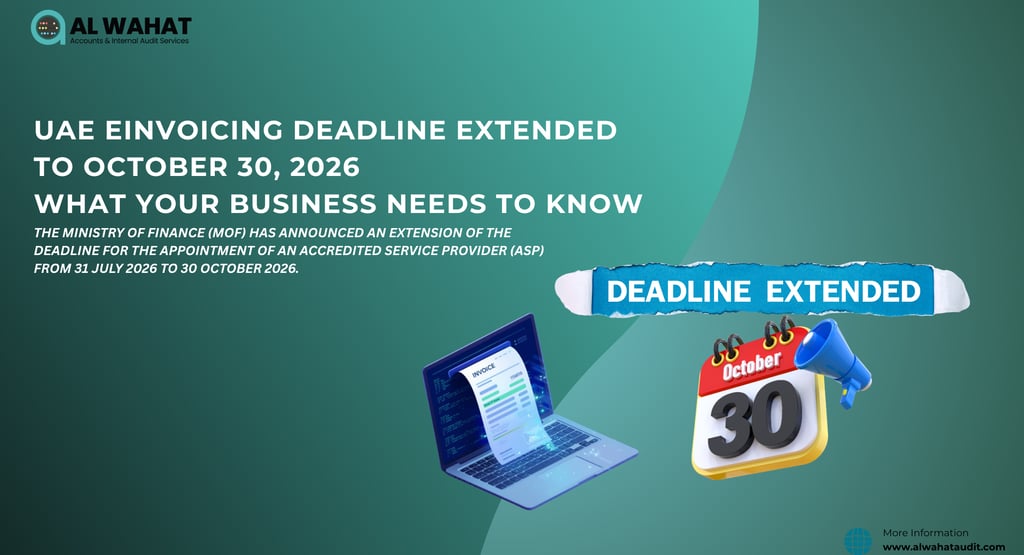
The UAE Ministry of Finance has officially extended the deadline for businesses to appoint an Accredited Service Provider (ASP) under the national eInvoicing framework. Through Ministerial Decision No. 244 of 2025, the deadline has moved from 31 July 2026 to 30 October 2026. The mandatory eInvoicing rollout itself begins 1 January 2027, starting with businesses generating more than AED 50 million in annual turnover, with smaller businesses following in later phases.
This extension offers breathing room — but not permission to delay.
What Is the UAE e-Invoicing System?
The UAE’s e-Invoicing system replaces traditional paper and PDF invoices with structured, machine-readable electronic invoices that must pass through a government-approved Accredited Service Provider before reaching the Federal Tax Authority. The UAE has adopted a decentralised “five-corner” model covering Business-to-Business and Business-to-Government transactions, with scope set to expand over time.
Who Is Affected?
The October 30 deadline applies to all businesses required to appoint an ASP ahead of the January 2027 rollout. Phase one covers companies with annual revenues above AED 50 million. Businesses below this threshold should still begin preparing — the mandate will expand to all businesses, and early action significantly reduces risk.
Why You Should Not Wait?
Industry estimates suggest approximately 90% of UAE businesses have not yet begun their eInvoicing transition. As demand for the 28 FTA-approved ASPs rises closer to the deadline, businesses that delay risk facing provider backlogs, system integration challenges, and insufficient time for testing. Companies with complex invoicing systems or multiple ERP platforms face even longer implementation timelines.
What Your Business Must Do Now?
Start by confirming your revenue threshold and compliance obligation. Select an ASP from the FTA-approved list and review whether your current accounting or ERP systems can support machine-readable invoices. Conduct a compliance gap analysis, upgrade where necessary, update your VAT reporting processes, and train your finance team. Most importantly, set an internal deadline well ahead of October 30 to allow adequate time for testing.
How Al Wahat Can Help?
At Al Wahat Accounts and Internal Audit Services, we guide businesses through every stage of eInvoicing compliance — from initial assessment and ASP selection to full implementation and staff training. The deadline has been extended. The obligation has not. Contact us today to start your compliance journey.
Disclaimer
This blog is for general informational purposes only and does not constitute professional tax, legal, or financial advice. Readers should verify all information with official sources including the UAE Ministry of Finance and the FTA. Al Wahat Accounts and Internal Audit Services shall not be held liable for any loss arising from reliance on the content herein.
Address
Faisal 2 Bldg, Office No 203, King Faisal St, Al Nad- Al Qasimia, Sharjah, UAE
Level 17, World Trade Center, Khalifa Bin Zayed, the first street- Abudhabi
Unit 32 -
4th Floor, AWR Properties - Al Fahidi Heights Office Tower, beside Central Mall ,near Sharaf DG metro station exit 4,Dubai ,U.A.E
Contacts
info@alwahataudit.com
+971589373943
We empower you to make well-informed decisions and successfully attain your financial objectives.


All copyrights reserved @Al-Wahat Accounts & Internal Audits | Designed - Abhijith S J
Subscribe to our newsletter